

Mrs. Flint’s house was the biggest house in town and was, therefore, the biggest I had ever seen. I’d meant to knock gently, but the iron knocker slipped out of my bulky glove and crashed onto its metal plate. Mrs. Flint opened the door herself and said in a gentle but instructive voice, “Next time, use the doorbell, dear.”
I felt right then that I could work for her, even though I was a rebellious girl sent out to do domestic work by a mother who thought I dreamed too much. I was sixteen years old and would work for the Flints for the next forty years.
I know now that the house wasn’t as enormous as it seemed to me then. It had high ceilings and beautiful walnut woodwork, trestles above the doors, large windows, hardwood floors with old oriental rugs in the parlor and dining room, two bathrooms with footed bathtubs, one with a makeshift shower, a powder room, a telephone alcove, four bedrooms, a kitchen as big as my family home’s whole downstairs, and a sun porch I fell in love with.
My mother had referred to Mrs. Flint as “quality.” On that first day, I began to understand what she meant. On the last day, I would still be learning.
Dr. Flint was an orthodontist. He stood up when I was brought into his study to meet him. His breath smelled of mouthwash, and his hands were white as if they’d never been exposed to the sun. There was a stiffness to him as if he were shy, a characteristic that I came to recognize later as courtliness. There was a son, Freddie, eight years younger than I, who begged to play checkers with me.
After Mrs. Flint had shown me the house, she brought me back into the parlor.
“This is my Limoges collection,” she said. It was an assortment of china figures, mostly animals, sitting on little hinged boxes. My mother would have called them “knick-knacks.” The collection was housed in a glass cabinet, locked by a key with a gold tassel hanging from it. Mrs. Flint unlocked the cabinet and picked up the bride and groom.
“This is the first one Dr. Flint gave me,” she said. “When I raised the lid, I found a diamond ring. That was how he asked me to marry him.”
I thought the figures were kind of ugly, the features indistinct and the colors washed out, but I understood their sentimental value. Mrs. Flint put the bride and groom back into the cabinet and locked it.
“I will dust the Limoges myself,” she said. She knew how to give an order as though it were mere information.
We agreed on my pay and the hours I would work, and then, instead of sending me home, she sent me to the kitchen to get some hot chocolate from Mrs. Bailey, who lived on the third floor, and to play checkers with Freddie. In those early years, she never forgot that, in some ways, I was still a little girl. When I graduated from high school, she increased my hours and gave me a key to the house. That summer, when they went to Europe for a month, as they always did, and Mrs. Bailey was visiting family in Cincinnati, they put me in charge of the house.
The first time I went in by myself, it was very, very quiet. I emptied all the wastebaskets like I always did and started on the special jobs I was to accomplish in their absence—waxing all the woodwork, the banisters, the piano and other furniture; cleaning carpets, wall coverings, and light fixtures. I was not to touch Mrs. Bailey’s kitchen, and I didn’t.
The work went by fast. At the end of my four hours each day, I would go up to the sun room and sit in the deep wicker rocking chair with my hands folded in my lap as if I were the lady of the house. I would think about Ray, the boy I would see that night, make up ways he would ask me to marry him, and imagine ways I would say “yes.”
After three weeks, everything was finished. I knew that it would take me just two days to dust and clean all over again, and I was looking for chores to fill my time. My eyes fell on the Limoges figures. I turned the gold-tasseled key and opened the cabinet door. I would dust every single one carefully, clean the glass shelves, and put the figures back exactly where they belonged. After two years, I still didn’t like them, but I understood why Mrs. Flint loved them. Dr. Flint had given her one for every birthday and anniversary since they’d been married. In the beginning, when they didn’t have much money, Mrs. Flint said that the boxes had little notes in them. Later they contained rings, diamond earrings, or miniature drawings depicting larger gifts that couldn’t have fit in the boxes.
As I removed the figures, I discovered that some boxes still had notes in them. One said, “I can’t imagine not loving you.” Another said, “You are endlessly fascinating.” After I read, “About last night,” I stopped reading them. I went to the wicker rocking chair and thought about Ray, who was my fiancé now. I wanted to be adored and desired, always and forever. I thought about the Flints. I realized that sometimes a note is more important than a gift. Beneath the Flints’ gracious demeanor, did passion still burn?
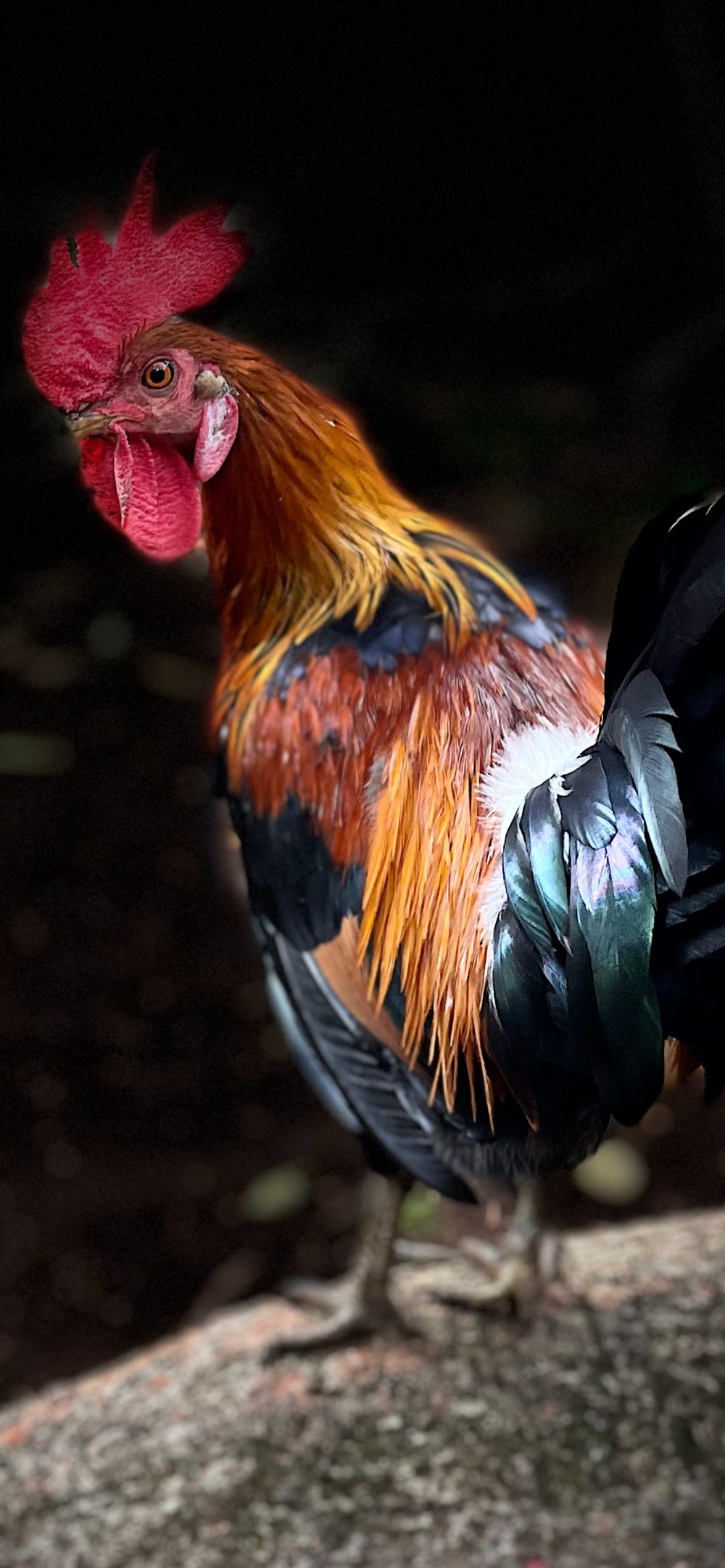
It happened the next day. I had removed all the figures and polished the inside of the cabinet. I was putting everything back, very carefully, very carefully, when the peacock somehow tipped over and broke the rooster. With shaking hands, I put the rest of the figures in the cabinet and locked the door. I took the rooster home with me.
That night Ray held me while I cried.
“You need to tell her,” he said.
“I can’t! I can’t face her!”
“Owning up to blame is better than living with shame,” he said, stroking my hair. I knew this would go in his wisdom book. He was, indeed, the wisest boy I knew. I didn’t know why he loved me.
“I can’t!” I cried again.
“Let me see it,” he sighed.
I took the plastic bag out of my purse. The box was intact. He opened it.
“Nothing in it,” he said. “I guess we could find another rooster and glue it on the lid. With luck, she’ll never know the difference.”
And we did find one, just the right size, at DeClark’s Hallmark store. It was almost the same color as the broken rooster. Ray glued it to the box. I put it in its place in the cabinet the next day.
After their return, Mrs. Flint said that the house looked beautiful. I had polished the front hall with Pine-Sol just before they arrived because Mrs. Flint loved the way it made the house smell clean when she walked in the door. Freddie had brought me a souvenir spoon from every country they had visited, and Mrs. Flint gave me an elegant purse that I would never carry.
And I waited to be fired. I waited week after week, month after month for her to discover the false rooster. After a while, I decided that if she hadn’t noticed it yet, she wasn’t going to. And that is how it went.
They took Freddie to boarding school that fall, and they put me in charge of the house again. I continued to work for the Flints even after I married Ray and had two sweet little girls and a contrary boy who was killed drag-racing his first car. My first-born. My precious Robert. It put what felt like a permanent wedge between Ray and me.
Dr. Flint died of a heart attack when Mrs. Flint was fifty-six. She lived another twenty years with a broken heart. Freddie became a stockbroker and married a doctor. They had two children. They rarely visited, but Mrs. Flint stayed a month with them every year.
Ray confessed an affair and was now begging me to forgive him. I still loved him, but he had broken my heart. I moved in with Mrs. Flint and lived on the third floor in Mrs. Bailey’s old room.
Sometimes, when Mrs. Flint was away, I would wake up and see Ray shoveling the snow from the long walk to the front door. He maintained my car, and one day, I found a new car in the driveway. It was as if he were trying to earn my forgiveness, and his tasks were like the notes that Dr. Flint used to leave for Mrs. Flint in the Limoges boxes.
On one of Mrs. Flint’s visits to Freddie, she had a stroke, and then another, and then she died. The house, which had just seemed empty when she was away, lost its fascination for me. I didn’t want to be in that house anymore. I moved back in with Ray.
After the funeral, Freddie and I talked. We were standing in front of the Limoges cabinet. I knew by then what Limoges was.
Freddie said, “She wanted you to have one of these. She said that you were to pick whichever one you wanted. Some of them are quite valuable, you know.”
I looked at the figures. You could tell that they hadn’t been handled in a long time. “I’ll take the rooster,” I said. Freddie reached for it.
“That’s funny,” he said. “Her instructions were that if you picked the rooster, you were to have another.”
I slipped the rooster into my pocket.
“This is fine,” I said.
“Take the peacock,” Freddie urged. “It’s the best.”
“I hate that peacock,” I said.
“You could sell it on eBay,” Freddie said. “You and Ray could take a second honeymoon on what it would bring.”
I felt the rough crack where the rooster’s feet were glued to the base. Had Mrs. Flint always known? Was she wise, like Ray?
I put a note to myself in the rooster. It said, “The most generous behavior is forgiveness.”
I put the rooster on the fireplace mantle in my living room next to the picture of Robert. I thought of all the things I wish I’d done differently. The mantle had only two objects on it, but it was complete. I put a note in the peacock that said, “A man who can’t live with shame is a good man.”
I gave the peacock to Ray.

*“Knick-Knack” is one of four finalists from The Vincent Brothers Review’s HOUSEKEEPING-themed short story contest. The other three finalists—“Aidan and Isobel” by Ed Davis, “The Wolf Girl” by Ant Torres, and “First, You Crack” by Diz Warner—have also appeared in The Vincent Brothers Review Weekly Reader, and our readers will be surveyed to choose the final place awards for this “Housekeeping” contest. Stay tuned!

Lee Huntington is a playwright and short story writer from Yellow Springs, Ohio. She is currently working on a collection of stories titled Small Town Tales.